
PracticeVCE offers the best self-assessment software for the L6M1 exam. This desktop-based practice exam provides valid and up-to-date L6M1 practice test questions. You can customize the software by adjusting the time and number of Strategic Ethical Leadership (L6M1) questions to your preferences. Additionally, you can try a free demo of the L6M1 Practice Test. This software keeps track of all your L6M1 practice exam attempts, allowing you to monitor your progress and improve your Strategic Ethical Leadership (L6M1) exam preparation.
PracticeVCE is the leader in the latest CIPS L6M1 Exam Certification and exam preparation provider. Our resources are constantly being revised and updated, with a close correlation. If you prepare CIPS L6M1 certification, you will want to begin your training, so as to guarantee to pass your exam. As most of our exam questions are updated monthly, you will get the best resources with market-fresh quality and reliability assurance.
The PracticeVCE is committed to ace the L6M1 exam preparation and success journey successfully in a short time period. To achieve this objective the PracticeVCE is offering Strategic Ethical Leadership (L6M1) practice test questions with high-in-demand features. The main objective of PracticeVCE CIPS L6M1 Practice Test questions features to assist the L6M1 exam candidates with quick and complete CIPS L6M1 exam preparation.
| Topic | Details |
|---|---|
| Topic 1 |
|
| Topic 2 |
|
| Topic 3 |
|
| Topic 4 |
|
| Topic 5 |
|
NEW QUESTION # 14
SIMULATION
Discuss the following strategies for resolving conflict: prevention, conflict management and conflict resolution. Provide examples of where these strategies may be appropriate, giving advantages and disadvantages to each (25 points)
Answer:
Explanation:
See the Answer is the explanation
Explanation:
Overall explanation
Below you will find how you can plan and draft the essay. Remember this is an example of one way you could approach the question. At Level 6 the questions are much more open so your response may be completely different and that's okay.
Essay plan
Intro - conflict is part of human nature
P1 - prevention, example, advantages, disadvantages
P2 - conflict management, example, advantages, disadvantages
P3 - conflict resolution, example, advantages, disadvantages
Conclusion - which one depends on people involved, nature of conflict and severity.
Example Essay
Conflict is a natural part of human interaction and can occur in various contexts, including personal relationships, workplaces, and communities. To address conflicts in the workplace effectively, organizations often employ three primary strategies: prevention, conflict management, and conflict resolution. Each strategy has its advantages and disadvantages, and their appropriateness depends on the specific situation and the parties involved.
Conflict Prevention: Conflict prevention involves proactively identifying potential sources of conflict and taking measures to prevent them from escalating into disputes. For example an organization implements clear communication channels and policies to address employee grievances promptly, reducing the likelihood of conflicts stemming from miscommunication. Another example may be a line manager and new employee discussing their expectations and boundaries early in their relationship to avoid misunderstandings that could lead to conflicts later.
Advantages:
- Cost-effective: Preventing conflicts is often more cost-effective than dealing with their consequences.
- Preserves relationships: It helps maintain positive relationships by avoiding unnecessary tension and hostility.
- Promotes productivity: In a workplace, conflict prevention can lead to a more harmonious and productive environment. People feel more comfortable and less stressed when they know where they stand.
Disadvantages:
- Not always possible: Some conflicts are inevitable, and prevention may not address deeply rooted issues. It's also not possible to predict every conflict. Prevention only works if you foresee issues.
- Time-consuming: Implementing preventive measures can require time and effort. Especially if it's not known whether a conflict will arise or not.
Conflict Management: Conflict management focuses on addressing conflicts as they arise, with the aim of minimizing their negative effects and finding mutually acceptable solutions. People openly discuss the conflict with the aim of reaching a mutual understanding of the disagreement. This approach requires a supportive leader trained in group skills and is usually used to try and prevent, or at least minimise, conflicts as they arise. For example, in a workplace two colleagues disagree about the best way to approach a task - they take the discussion to a meeting room with their supervisor and reach an agreeable outcome by finding common ground such as splitting the task into two parts, and each taking responsibility for their part.
Advantages:
- Addresses issues directly: Conflict management acknowledges the problem and attempts to find solutions.
- Preserves relationships: When managed well, conflicts can strengthen relationships by fostering understanding and compromise.
- Opportunity for growth: It can lead to personal and organizational growth by addressing underlying issues.
Disadvantages:
- Time and energy-consuming: Conflict management can be emotionally draining and time-consuming.
- Risk of escalation: If not handled properly, conflicts can escalate and get worse, causing more harm in the long term.
- No guarantee of resolution: Some conflicts may not have easily achievable solutions.
Conflict Resolution. Conflict resolution is the process of finding a definitive solution to a conflict, often resulting in a formal agreement that satisfies all parties. It is used after conflict has already broken out and sometimes when conflict management has already failed. A 3rd party such as a Liaison Officer mediates a resolution meeting, setting rules and procedures on behaviour conduct. An example of this is a dispute between buyer and supplier over a contract term which is taken to alternative dispute resolution such as arbitration. Another example may be a dispute between two employees which is taken to HR and each employee has a representative/ witness present.
Advantages:
- Permanent solution: Conflict resolution aims to resolve the issue once and for all. Unlike the other two approaches, the decision is final and cannot be undone.
- Legal and formal: It can be legally binding and provide a clear framework for compliance, unlike the other two options.
Disadvantages:
- Time-consuming: Conflict resolution can take a significant amount of time, especially if legal proceedings are involved.
- Costly: It can be expensive, particularly when legal or professional mediation services are required such as contract disputes between buyers and sellers.
- May not satisfy all parties: Some parties may feel they've lost or been unfairly treated, which can lead to lingering resentment.
In practice, the choice of strategy depends on the nature and severity of the conflict, the parties involved, and the desired outcomes. Often, a combination of these strategies may be employed to effectively address conflicts in various situations. Effective conflict management requires adaptability and a careful assessment of the specific circumstances to determine the most appropriate approach.
Tutor Notes
- there are so many parts to this question. I recommend doing a quick plan at the start like I've done. You can then flick back to this once you've finished your essay to check you've included all the points. For example, did you write the disadvantage of conflict management? Did you include an example of conflict resolution? There's so many things you could accidentally miss out here so do double check your work at the end.
- Students often get conflict management and conflict resolution mixed-up. Hopefully the above essay helps clear this up if you weren't sure before.
- Some quotes on conflict management which you could use in your essay:
"In the middle of every difficulty lies opportunity." - Albert Einstein
"If you want to resolve a conflict, you must be willing to compromise." - John Hume
- Study guide p. 254
NEW QUESTION # 15
SIMULATION
Sarah is the manager of a small cake shop. She employs 8 staff members and has several local suppliers. Her approach to leadership is the Contingency approach. Explain what is meant by this approach (5 points) and discuss how Sarah could use this approach to ensure her business is successful. (25 points)
Answer:
Explanation:
See the Answer is the explanation
Explanation:
Introduction
Effective leadership plays a crucial role in the success of a business, especially in small enterprises where employee motivation, supplier management, and operational efficiency directly impact profitability. Leadership styles should be adaptable to different situations, team dynamics, and external challenges.
Sarah, the manager of a small cake shop, adopts the Contingency Approach to Leadership, which means she adjusts her leadership style based on the specific circumstances her business faces. This essay will first explain what the Contingency Approach is and then discuss how Sarah can apply it to ensure her cake shop thrives.
1. What is the Contingency Approach to Leadership? (5 Points)
Definition
The Contingency Approach to Leadership suggests that there is no single best way to lead-instead, the best leadership style depends on the situation. A leader must evaluate environmental factors, team capabilities, business challenges, and supplier relationships to determine the most effective leadership style.
Key Principles of the Contingency Approach
Situational Adaptability - Leaders must adjust their behavior based on the context, team skills, and challenges.
Flexibility in Decision-Making - Some situations require authoritative leadership, while others benefit from a collaborative approach.
Focus on Environmental Factors - External factors such as market trends, customer demand, and supplier reliability influence leadership decisions.
Influence of Team Maturity - The leadership approach changes depending on whether employees are highly skilled and independent or require supervision and guidance.
Example of the Contingency Approach
If Sarah's cake shop faces a sudden staff shortage, she may need to adopt a directive leadership style, giving clear instructions to manage the crisis.
If she is introducing a new product line, she might collaborate with her team, encouraging creativity and innovation.
2. How Sarah Can Use the Contingency Approach to Ensure Business Success (20 Points) Sarah's cake shop operates in a highly customer-focused industry where quality, efficiency, and customer service are essential. Applying the Contingency Approach effectively can help her improve operations, manage staff effectively, and strengthen supplier relationships.
(A) Adjusting Leadership Style for Employee Management
Sarah employs 8 staff members with varying skill levels, meaning she must tailor her leadership style to each employee's capabilities.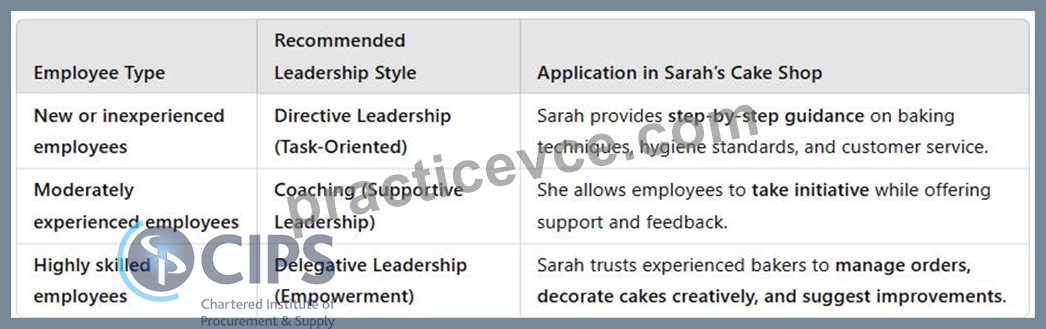
By adapting her approach to different staff members, Sarah ensures high productivity, job satisfaction, and skill development within her team.
(B) Supplier Relationship Management
Sarah's cake shop depends on local suppliers for ingredients such as flour, sugar, and dairy. A contingency approach helps her manage these relationships effectively:
Handling Reliable Suppliers (Low-Risk Situations)
Uses a collaborative leadership style, fostering strong long-term relationships.
Works closely with suppliers to negotiate bulk discounts and ensure high-quality ingredients.
Dealing with Supplier Disruptions (High-Risk Situations)
Uses directive leadership to make quick alternative sourcing decisions.
If a supplier fails to deliver ingredients on time, Sarah must quickly find replacements to keep operations running smoothly.
By adapting her approach based on supplier reliability, Sarah ensures consistent ingredient supply, cost efficiency, and business continuity.
(C) Responding to Business Challenges and Market Changes
The food industry is highly competitive, and Sarah must adjust her leadership approach to respond effectively to external challenges such as:
Seasonal Demand Fluctuations (Christmas, Weddings, Special Events)
Uses a participative approach, involving her team in planning for high-demand periods.
Encourages staff to suggest new cake designs, flavors, and promotional offers.
Handling Customer Complaints and Service Issues
Uses a customer-focused leadership approach, ensuring that employees prioritize customer satisfaction and feedback resolution.
Trains employees in effective communication and problem-solving.
Implementing New Technologies (e.g., Online Ordering System)
Uses a coaching approach, training staff step-by-step on the new system while gathering their feedback.
By staying flexible and responsive, Sarah ensures that her cake shop remains competitive, innovative, and customer-focused.
(D) Managing Workload and Crisis Situations
In any small business, unexpected crises can arise, such as staff shortages, equipment breakdowns, or raw material shortages. Sarah can use different leadership styles based on urgency:
Crisis Situations (e.g., Oven Malfunction, Sudden Staff Absences)
Uses a directive approach, giving clear instructions to ensure quick problem resolution.
Example: If a baker calls in sick on a busy day, Sarah reallocates tasks immediately to keep up with orders.
Daily Operations (Stable Work Conditions)
Uses a participative approach, allowing employees to contribute ideas for improving workflows and efficiency.
By using contingency-based leadership, Sarah ensures her cake shop runs smoothly under different circumstances.
(E) Encouraging Teamwork and Employee Motivation
A successful cake shop requires a motivated, engaged team. Sarah can use different leadership techniques to build a strong team culture:
Team Meetings and Brainstorming
Uses a democratic approach, encouraging employees to share creative cake designs and customer engagement strategies.
Recognizing Employee Achievements
Uses a supportive approach, rewarding employees for exceptional performance and customer service.
By adapting to different employee needs, Sarah builds a motivated, skilled, and loyal team, reducing turnover and improving overall performance.
Conclusion
The Contingency Approach to Leadership is an effective strategy for Sarah as it allows her to adapt to various challenges in her cake shop, ensuring smooth operations, strong supplier management, and motivated employees.
By modifying her leadership style based on the situation, employee skill levels, supplier performance, and business challenges, Sarah can:
✅ Develop a high-performing team by offering the right mix of guidance and independence.
✅ Manage supplier relationships effectively by adjusting her leadership approach based on reliability and market conditions.
✅ Handle operational challenges efficiently, ensuring business continuity and customer satisfaction.
Ultimately, flexibility and adaptability are key to her success, making the Contingency Approach an ideal leadership style for small business management.
NEW QUESTION # 16
SIMULATION
Explain the following types of dismissal: fair dismissal, unfair dismissal, summary dismissal, constructive dismissal and redundancy (15 points) How should an employee respond if they believe they believe that they have been let go by their employer unfairly? (10 points).
Answer:
Explanation:
See the Answer is the explanation
Explanation:
Overall explanation
Below you will find how you can plan and draft the essay. Remember this is an example of one way you could approach the question. At Level 6 the questions are much more open so your response may be completely different and that's okay.
Essay Plan
Introduction - complex area of law
Section 1 - each type of dismissal, explain and example
Section 2- what they should do; use internal channels first, seek advice (union / Citizens Advice), mediation, litigation via Employment Tribunal.
Example Essay
Employment termination is a complex area of employment law, and different types of dismissal carry distinct legal implications. In the United Kingdom, where employment law is well-established, employees are entitled to certain rights and protections when facing dismissal. This essay explores various types of dismissal, including fair dismissal, unfair dismissal, summary dismissal, constructive dismissal, and redundancy. It also discusses how employees should respond if they believe they have been unfairly dismissed.
Types of Dismissal:
Fair Dismissal: Fair dismissal occurs when an employer terminates an employee's contract with valid reasons that are recognized by law. Common grounds for fair dismissal include misconduct, lack of capability and statutory reasons. For example, an employee consistently failing to perform their job despite adequate training and support may be fairly dismissed for capability.
Unfair Dismissal: Unfair dismissal, on the other hand, happens when an employee is terminated without valid reasons or if the employer fails to follow the correct dismissal procedures. Employees with at least two years of continuous service have protection against unfair dismissal. For example if XYZ Ltd fire Employee X who has worked at the company for 5 years because there is a personality clash between them and the management, Employee X could claim unfair dismissal (personality clash is not a valid reason for dismissal).
Summary Dismissal: Summary dismissal, often referred to as instant or gross misconduct dismissal, occurs when an employer terminates an employee's contract without notice due to severe misconduct. It typically involves serious breaches of workplace rules or the law. For example if an employee is caught stealing, they may be fired on the spot without notice.
Constructive Dismissal: Constructive dismissal occurs when an employee resigns from their position due to an employer's fundamental breach of the employment contract, creating an unbearable working environment. An example of this is if the employer fails to provide the worker with the correct PPE to complete the work (for example in the Construction industry). Because the employee is unable to complete the work safely, they resign. In this instance, the 'blame' is put firmly on the fault of the employer for 'making' the employee resign.
Redundancy: Redundancy takes place when an employer dismisses an employee because the job role they held no longer exists, or the employer's business needs to reduce its workforce. Redundancy dismissals must adhere to specific procedures and fair selection criteri a. In the UK this is referred to as TUPE.
If an employee believes that they are being fired unfairly they can claim unfair dismissal. Firstly, they should initially consider raising their concerns internally through the company's grievance procedure. This allows for a formal process where grievances can be investigated and addressed. This is particularly useful in large organisations where workers may be fired by middle-managers who are not properly trained or aware of the legislation regarding this area. By raising a concern through a grievance policy, it allows the right people in the company such as HR or the senior leadership team, to fully assess the situation.
Secondly, the employee should seek advice from an organisation such as Citizen's Advice or their workers' union. They will be able to advise if the situation does amount to unfair dismissal. Getting a third party involved can help to bring in a new perspective and keep discussions positive and moving forward.
If it is believed that the unfair dismissal has merit, employees can contact ACAS (Advisory, Conciliation, and Arbitration Service) for early conciliation. ACAS may facilitate settlement discussions between the employee and employer to avoid legal proceedings. If internal processes and ACAS conciliation do not resolve the matter, employees can file a claim with the Employment Tribunal within specified time limits, asserting unfair dismissal. The time limit to claim is currently 3 months minus a day from the date you were dismissed. Employees may seek legal advice and representation during Employment Tribunal proceedings to ensure their rights are protected and they receive appropriate compensation if the claim is successful.
In conclusion, various types of dismissal exist, each with distinct legal implications. Employees should be aware of their rights and protections under UK employment law, particularly concerning unfair dismissal. It is important to remember that 'employment rights' in the UK are only granted after 2 years of service, and this is often a big factor when looking at this area of law. It is important for all employees in the UK to understand these types of dismissal as having appropriate responses empowers employees to seek redress when faced with unjust termination.
NEW QUESTION # 17
SIMULATION
Discuss internal and external sources of change (10 points). What is a Forcefield Analysis and how can this help a leader plan for change? (15 points)
Answer:
Explanation:
See the Answer is the explanation
Explanation:
Overall explanation
Below you will find how you can plan and draft the essay. Remember this is an example of one way you could approach the question. At Level 6 the questions are much more open so your response may be completely different and that's okay.
Essay Plan
Divide into two separate answers
1) Internal changes; personnel, systems, structure. External changes; STEEPLED and Porter - legislation, economy, technology, competitors.
2) Intro: what is a forcefield analysis? Explain how to do one. Then How can it help? Define objectives, impact on communication strategy Example Essay Change is a constant in the business world, and organizations must adapt to various internal and external forces to remain competitive and relevant. Understanding the sources of change is crucial for managing transformations effectively. In this essay, we will explore the distinction between internal and external sources of change and discuss how they impact personnel, processes, and company structure.
Sources of Internal Change within a Business:
People Changes: Changes in personnel, such as hiring, firing, promotions, and retirements, can have a profound impact on an organization. New hires may require training and onboarding, potentially affecting productivity during the transition. Terminations or layoffs may lead to temporary disruptions and workload adjustments for remaining employees. Moreover personnel changes can influence the organization's culture. New employees may bring different values and perspectives, while the loss of experienced employees can result in a shift in the workplace culture. Promotions and changes in leadership positions can influence decision-making, team dynamics, and the overall direction of the organization.
Systems Changes: Implementing or modifying systems, including software, technology, or operational procedures, can significantly affect how an organization operates. Well-planned systems changes can lead to increased operational efficiency, reduced errors, and improved decision-making, but employees may need time to adapt to new systems, potentially causing a temporary decrease in productivity. Moreover, systems changes can impact data storage, retrieval, and analysis, influencing how information is utilized within the organization.
Company Structure Changes: Altering the organization's structure, including hierarchies, departments, or reporting lines, can reshape how work is organized and executed. Employees who experience shifts in job roles, responsibilities, or reporting relationships, can affect job satisfaction and performance. It may also require adjustments in communication processes, potentially impacting the flow of information within the organization. A well-designed company structure can enhance efficiency and adaptability, while a poorly structured one may lead to inefficiencies and bureaucracy.
Sources of External Change Impacting a Business:
Legislation Changes: Changes in laws and regulations can have immediate and long-term consequences for businesses. Adapting to new regulations may require financial investments in compliance measures, training, or legal counsel. Businesses may need to modify processes and practices to ensure adherence to updated legal requirements. Companies that can proactively adapt to legislative changes may gain a competitive advantage by being compliant and avoiding penalties. An example of this is the upcoming changes to Public Sector Procurement Regulations which will take place in 2024, following the UK's departure from the EU.
Economic Changes: Economic shifts, such as recessions, inflation, or economic growth, can affect an organization's financial health and market position. Economic downturns can lead to decreased consumer spending and reduced revenue, requiring cost-cutting measures like layoffs or budget reductions. Conversely economic growth can present new market opportunities, prompting expansion, product diversification, or investment in research and development. Economic fluctuations can also disrupt supply chains, affecting inventory management, pricing, and delivery times.
Technological Changes: Rapid advancements in technology can drive changes in how businesses operate and compete. Embracing technological advancements can enhance operational efficiency, reduce costs, and improve customer experiences. Employees may require training to adapt to new technologies, and organizations may need to invest in digital infrastructure. Technology-driven innovations can disrupt traditional industries and create new competitive threats or opportunities. For example the music industry has seen huge changes in the past 10 years due to the increasing popularity of streaming platforms such as Apple Music and Spotify.
Competitor Actions: Actions taken by competitors, such as new product launches, marketing campaigns, or market entries, can influence an organization's market share and strategy. This may require adjustments in pricing, product offerings, or marketing strategies. An organisation should look at Porter's 5 Forces and STEEPLE analysis to fully understand potential external sources of change.
In the dynamic business environment, both internal and external sources of change play significant roles in shaping organizations. Recognizing these sources of change and effectively managing them are essential for organizations to succeed.
Forcefield Analysis
Lewin's Force Field Analysis is a valuable tool that can help a leader plan for change by providing a structured framework for understanding the forces at play in an organization when considering a change initiative. Developed by psychologist Kurt Lewin in 1951, this model helps leaders assess the driving forces that promote change and the restraining forces that resist it.
Identifying Driving and Restraining Forces:
Driving Forces: These are factors that push for change and support the desired change initiative. Identifying these forces helps leaders understand what is propelling the organization toward change. Examples of driving forces include market opportunities, customer demands, and performance improvement goals.
Restraining Forces: These are factors that oppose or hinder change. Recognizing these forces is crucial as they represent obstacles that need to be addressed or overcome. Restraining forces can include employee resistance, existing processes, or budget constraints.
Assessing the Balance:
After identifying driving and restraining forces, leaders can assess the balance between them. This analysis provides a clear picture of the overall readiness for change within the organization. If driving forces outweigh restraining forces, it suggests a favourable environment for change, while an imbalance in the other direction may require more effort to gain buy-in and overcome resistance.
Prioritizing Action Steps:
Once the forces are identified and their balance is assessed, leaders can prioritize action steps accordingly. For driving forces, leaders can focus on leveraging them further and ensuring that they continue to support the change. For restraining forces, strategies can be developed to mitigate or overcome them. This may involve addressing concerns, providing training, or reallocating resources.
How this can help a leader plan for change:
Force Field Analysis provides a foundation for developing a comprehensive change management plan. Leaders can use the insights gained to structure the plan, including defining specific objectives, timelines, and key performance indicators (KPIs) to measure progress.
Understanding the forces at play allows leaders to tailor their communication and engagement strategies. They can target communication efforts toward addressing the concerns and motivations of employees, stakeholders, and other relevant parties. By addressing restraining forces through effective communication, leaders can build support for the change.
The analysis doesn't end with the initiation of change; it continues throughout the change process. Leaders can continuously monitor the balance of forces and adjust their strategies as needed. If new restraining forces emerge or driving forces weaken, the change plan can be adapted accordingly to maintain momentum.
In summary, Lewin's Force Field Analysis provides leaders with a structured approach to understanding the dynamics of change within an organization. By identifying driving and restraining forces, leaders can better plan, execute, and manage change initiatives, ultimately increasing the likelihood of successful implementation and achieving desired outcomes.
Tutor Notes
- I have split my answers here and clearly signposted this to the examiner. A top tip is to consider the examiner's first look at your essay. By doing this, they can clearly see within the first 10 seconds that I've understood the question and I've answered all parts. It's a way to set yourself up for success. So, use all the headings and spacings you can. I don't think you can use bold in the exam, but you could use capital letters instead.
- A way to improve on the above would be to give more examples. For the Forcefield analysis you could talk about a potential change at company X being the introduction of a new product line, and say what the forces for and against would be. This would really hammer-home to the examiner you know your stuff.
- Sources of change - p. 224 (note the study guide says internal sources are people, structure and processes, I used the word system in my essay above rather than processes but it's the same thing). External sources of change are anything from STEEPLED and Porter. Remember the question is only worth 10 points, so 3 or 4 internal and 3 or 4 internal is more than enough. Don't do a full STEEPLED. You don't have time.
- Forcefield analysis is p. 232
NEW QUESTION # 18
SIMULATION
Describe and evaluate one model that can be used to classify different forms of stakeholders (25 points)
Answer:
Explanation:
See the Answer is the explanation
Explanation:
Stakeholder Classification: Using Mendelow's Matrix
Stakeholders play a crucial role in the success of an organization, influencing decisions, resources, and operations. To effectively manage stakeholders, organizations need a model that helps classify and prioritize stakeholders based on their influence and interest. One widely used framework is Mendelow's Stakeholder Matrix.
This essay describes Mendelow's Matrix, evaluates its effectiveness, and discusses its advantages and limitations.
Mendelow's Stakeholder Matrix
Mendelow's Stakeholder Matrix (1991) is a strategic tool that classifies stakeholders based on two key factors:
Power - The ability of a stakeholder to influence the organization's decision-making.
Interest - The level of concern a stakeholder has about the organization's activities.
Based on these factors, stakeholders are placed into one of four quadrants:
Stakeholder Group
Power
Interest
Management Strategy
Key Players
High
High
Actively engage and involve
Keep Satisfied
High
Low
Monitor closely, engage when necessary
Keep Informed
Low
High
Provide regular updates, listen to concerns
Minimal Effort
Low
Low
Monitor but minimal engagement
1. Key Players (High Power, High Interest)
These stakeholders have significant influence over the organization and strong interest in its operations.
Examples:
✔ Senior executives, major shareholders, government regulators.
✔ Large customers or strategic suppliers.
Management Strategy:
✔ Actively involve them in decision-making.
✔ Consult regularly and address their concerns immediately.
Evaluation:
✔ Managing this group well ensures strong support for company initiatives.
✘ Ignoring them can lead to significant resistance and business risks.
2. Keep Satisfied (High Power, Low Interest)
These stakeholders have high power but low interest, meaning they can affect the organization significantly if ignored.
Examples:
✔ Government bodies that enforce regulations but do not intervene unless necessary.
✔ Wealthy investors with minimal involvement in daily operations.
Management Strategy:
✔ Engage periodically to keep them satisfied.
✔ Provide updates on key decisions without overwhelming them.
Evaluation:
✔ Proper management prevents unexpected opposition.
✘ If engagement is too frequent, they may lose interest or disengage.
3. Keep Informed (Low Power, High Interest)
These stakeholders do not have direct power but are highly interested in the company's actions.
Examples:
✔ Employees, local communities, NGOs concerned about sustainability.
✔ Small-scale suppliers who depend on the company.
Management Strategy:
✔ Communicate regularly through reports, newsletters, or meetings.
✔ Listen to concerns and provide transparency.
Evaluation:
✔ Keeping them engaged builds positive public relations and internal morale.
✘ If ignored, they may escalate concerns to higher-power stakeholders.
4. Minimal Effort (Low Power, Low Interest)
These stakeholders have little influence and low interest, meaning they do not require significant attention.
Examples:
✔ General public who have no direct impact on the company.
✔ Non-core suppliers with small contracts.
Management Strategy:
✔ Monitor their concerns occasionally.
✔ Avoid unnecessary engagement unless their influence changes.
Evaluation:
✔ Avoiding excessive engagement saves time and resources.
✘ If their interest or power grows, they may require reclassification.
Evaluation of Mendelow's Stakeholder Matrix
Advantages of the Model
✔ Simple and Practical - Easy to understand and apply in various industries.
✔ Helps Prioritize Stakeholders - Ensures critical stakeholders receive appropriate attention.
✔ Supports Strategic Decision-Making - Guides communication and engagement efforts.
✔ Adaptable - Can be used for mergers, change management, procurement, and public relations.
Limitations of the Model
✘ Does Not Capture Stakeholder Dynamics - Stakeholder power and interest change over time, requiring constant reassessment.
✘ Overlooks Stakeholder Relationships - Some stakeholders influence others (e.g., media can amplify employee concerns).
✘ Power and Interest Can Be Subjective - Classifying stakeholders requires judgment and regular review.
Conclusion
Mendelow's Stakeholder Matrix is a powerful tool for classifying and managing stakeholders in any organization. By categorizing stakeholders based on power and interest, leaders can develop effective engagement strategies and mitigate risks associated with key stakeholders. However, stakeholder influence is fluid, so ongoing analysis is necessary for long-term success. Despite its limitations, this model remains a fundamental framework for strategic stakeholder management.
NEW QUESTION # 19
......
If you free download the demos of our L6M1 study guide to have a try, then you will find that rather than solely theory-oriented, our L6M1 actual exam provides practice atmosphere when you download them, you can practice every day just like answering on the real L6M1 Practice Exam. We can help you demonstrate your personal ability and our L6M1 exam materials are the product you cannot miss.
L6M1 Customizable Exam Mode: https://www.practicevce.com/CIPS/L6M1-practice-exam-dumps.html